Category: Tarka

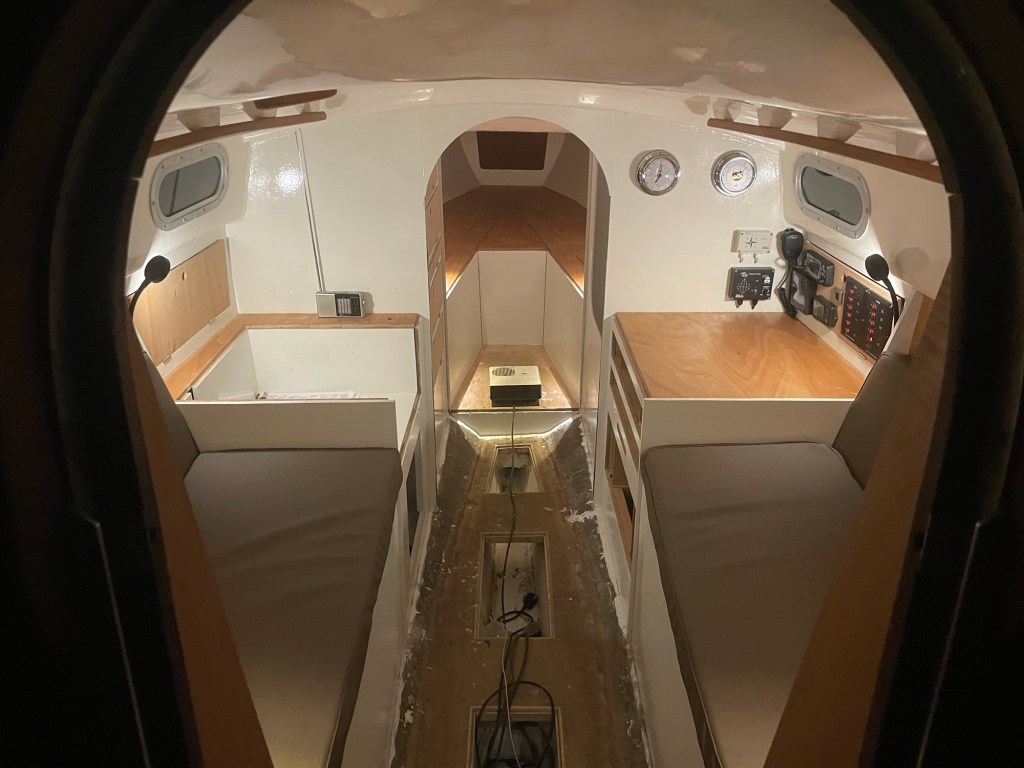
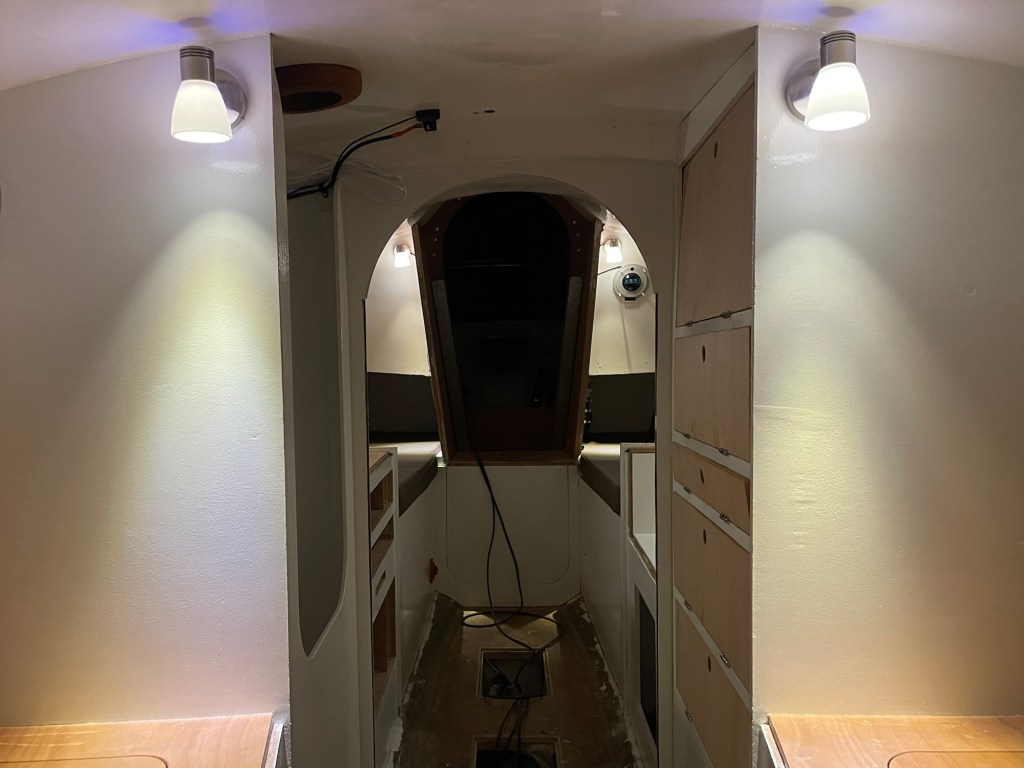
  • End of rough interior install

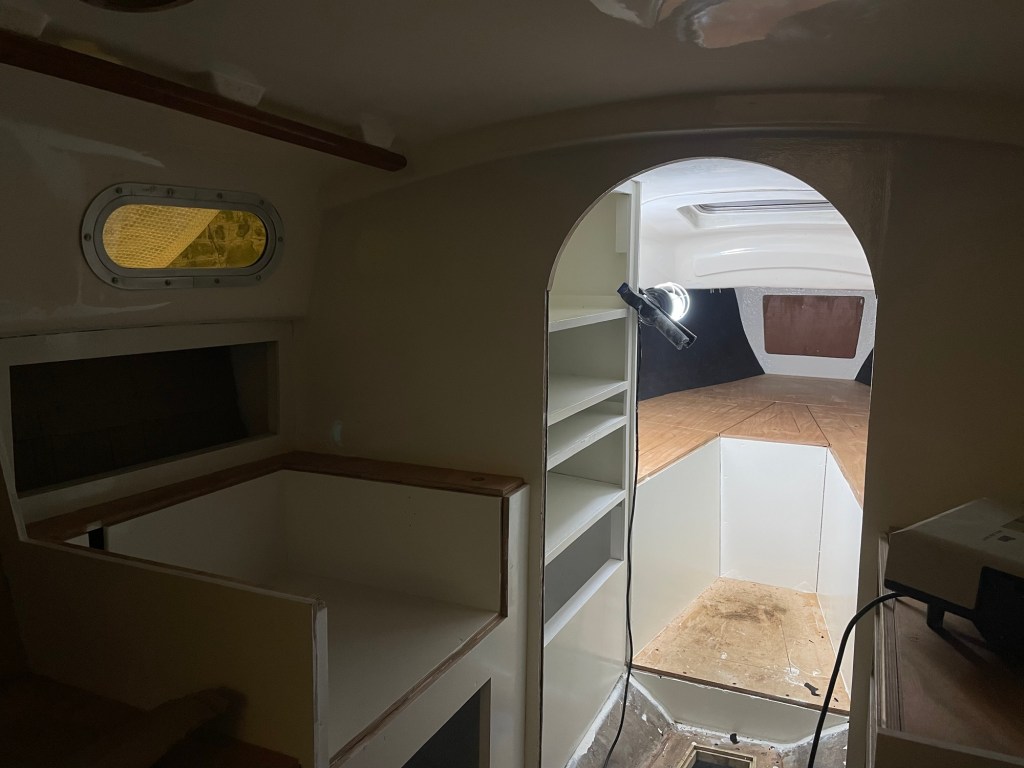
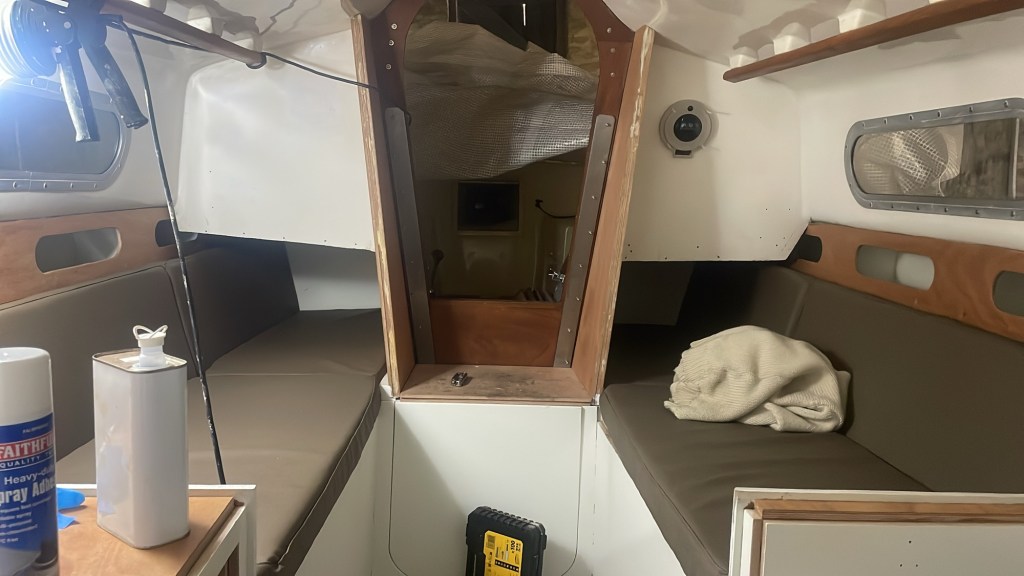
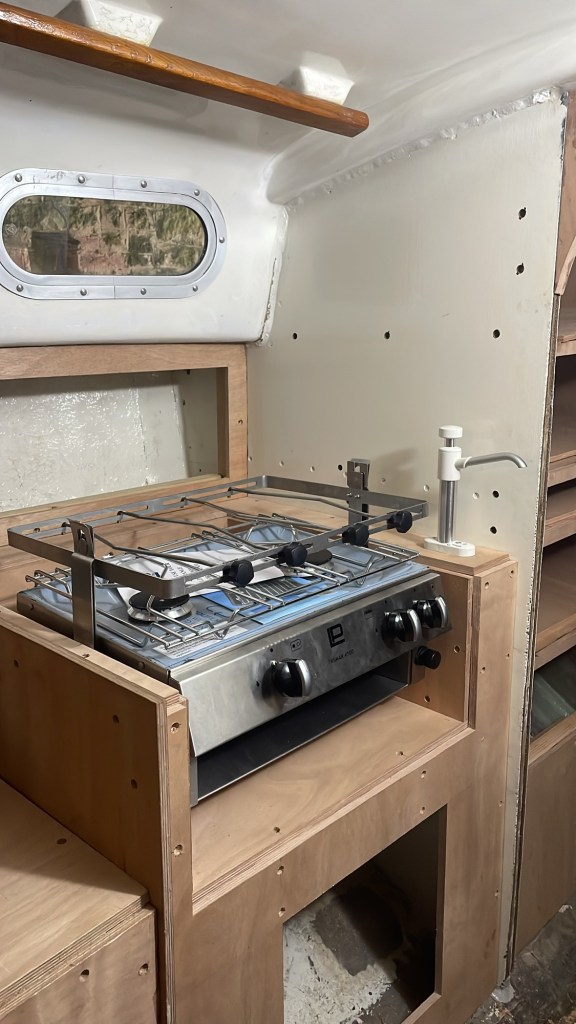
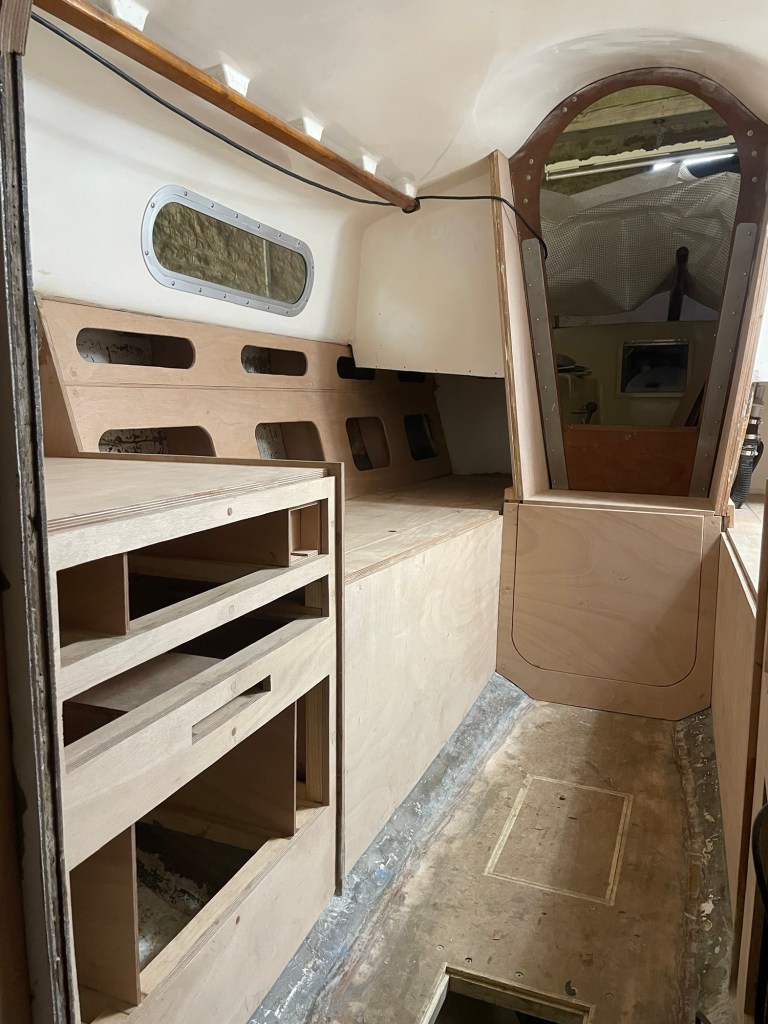
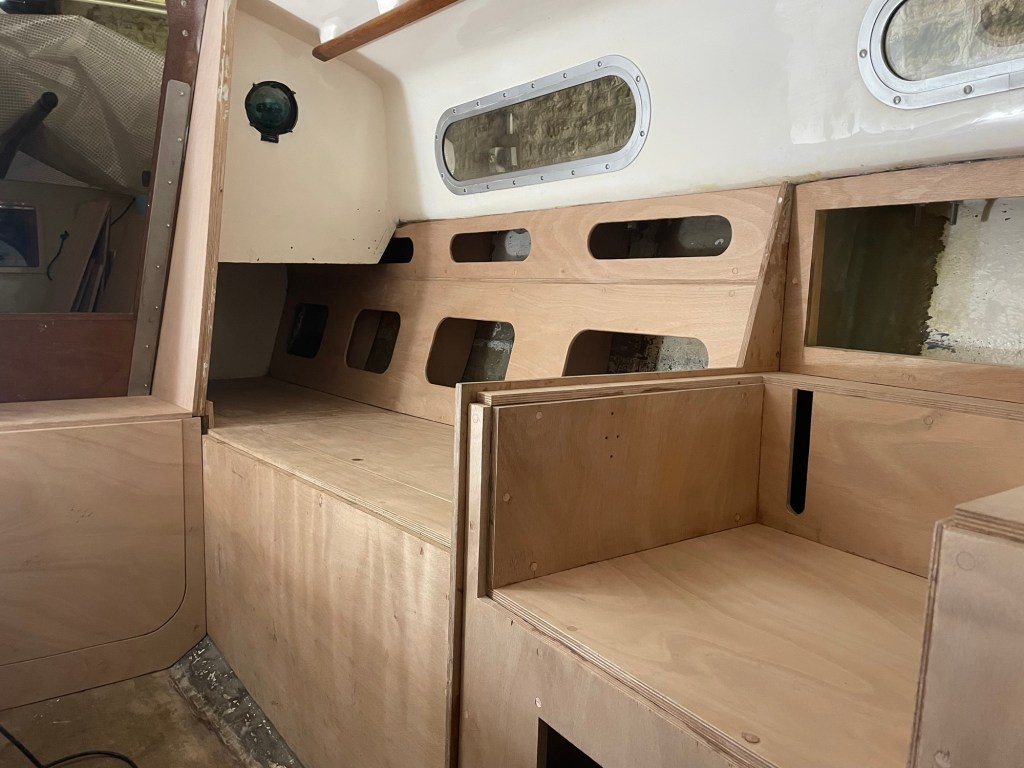
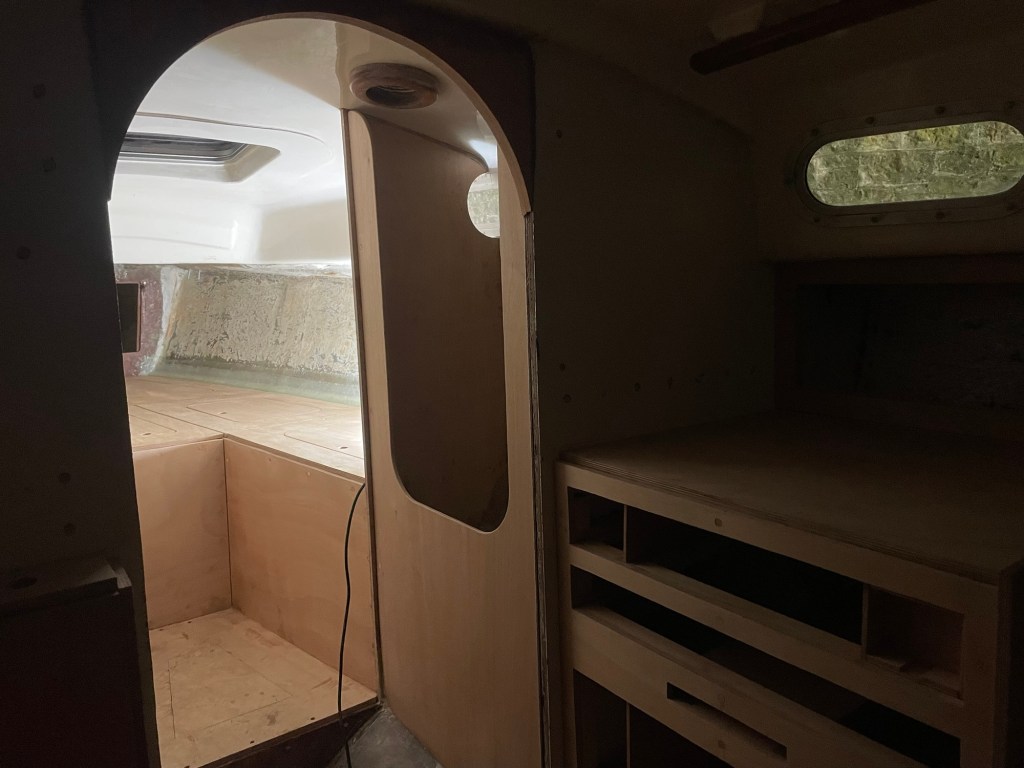
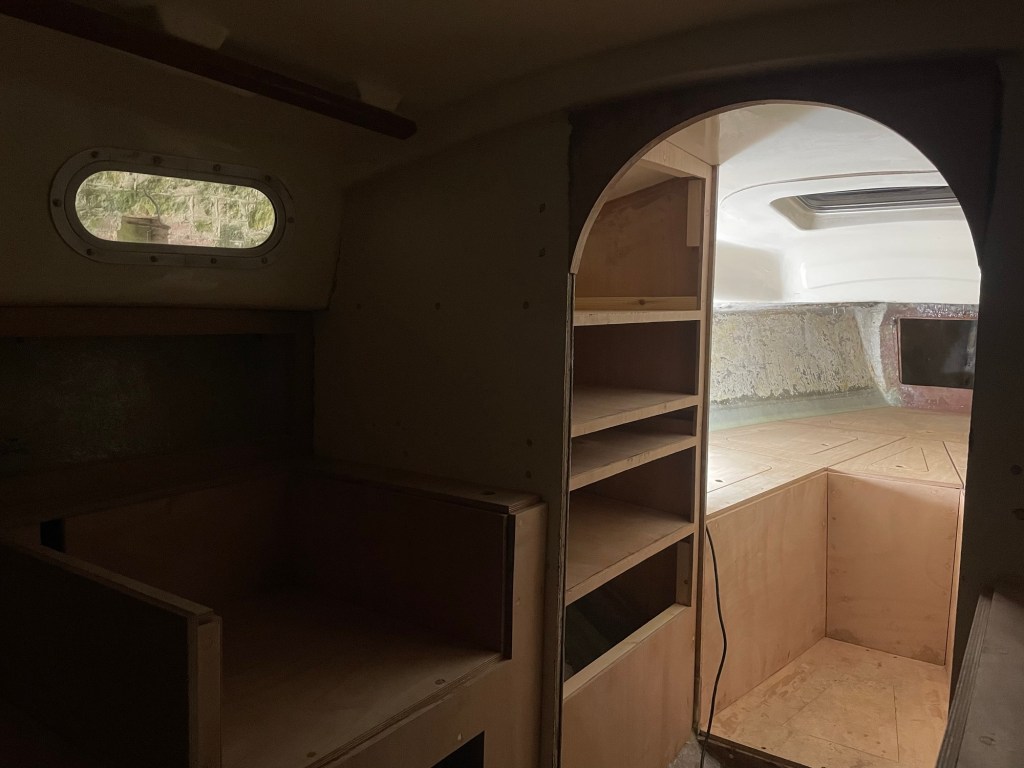
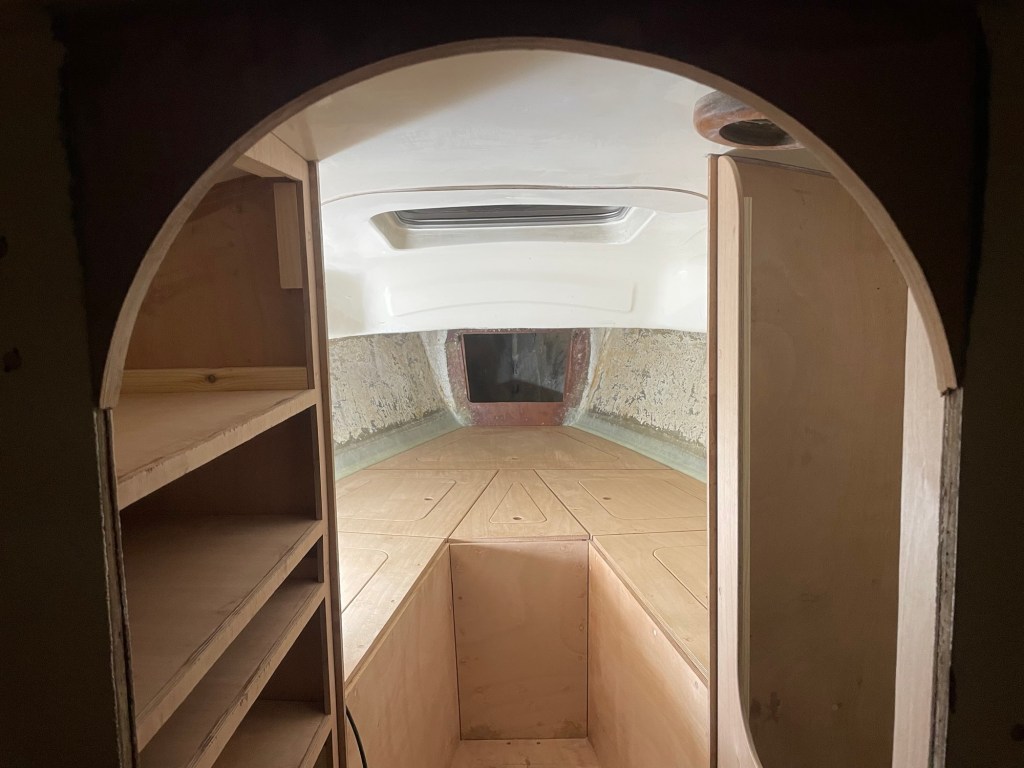
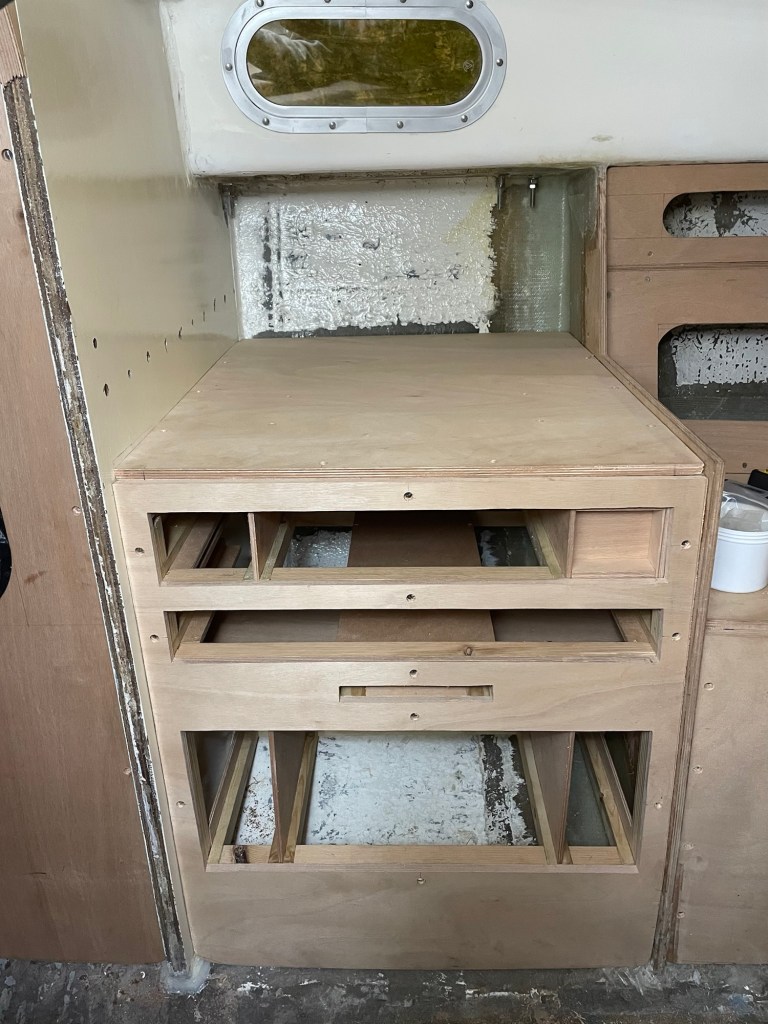
    The new year was tough – removing all the pieces I’d finished over previous months and preparing them for bonding took a good few weeks, and despite the knowledge it would all be put back together again soon, it was incredibly demoralising. I also built the galley unit which houses the newly available gimbaling gas stove/grill and hand pump tap.

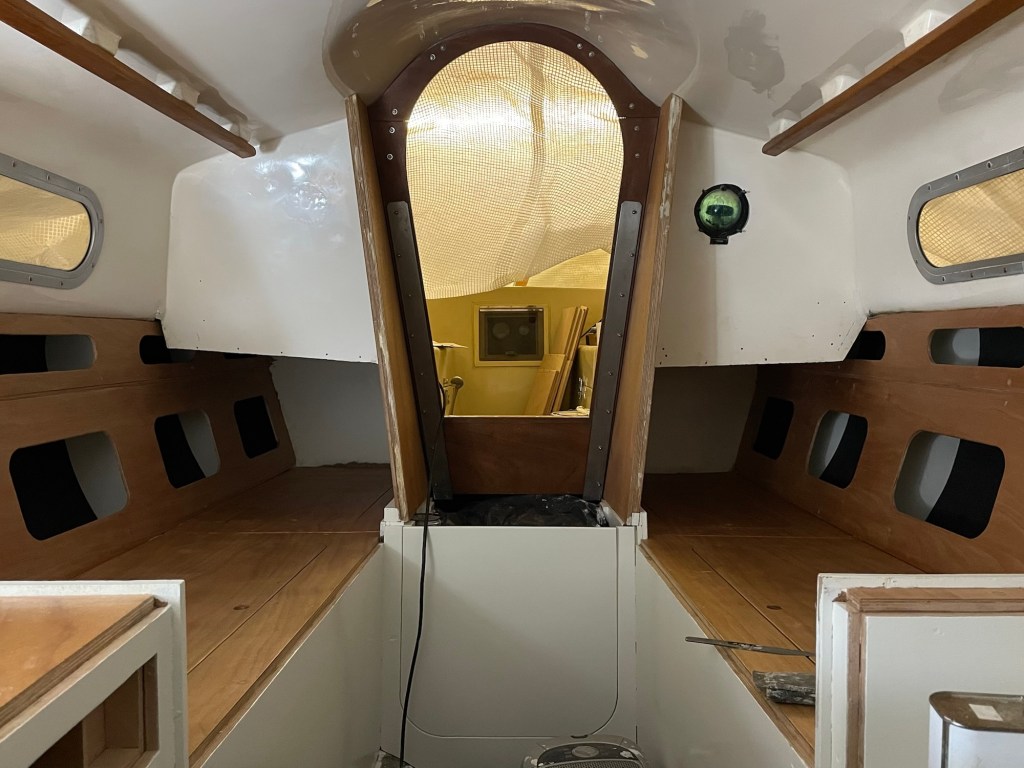
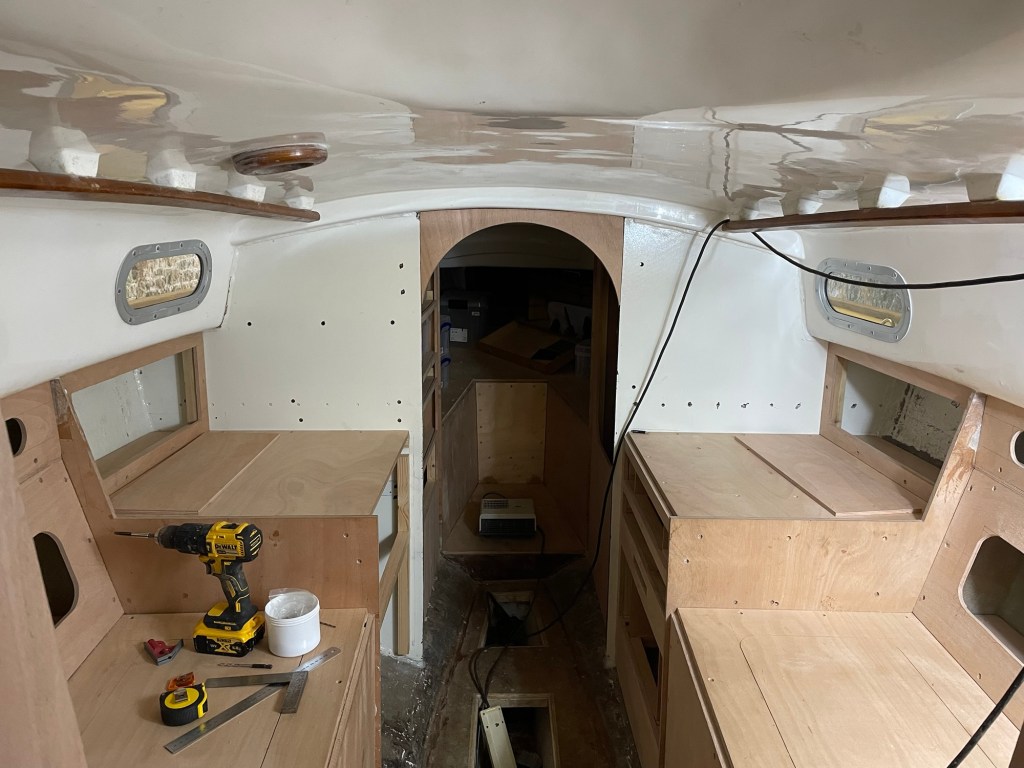
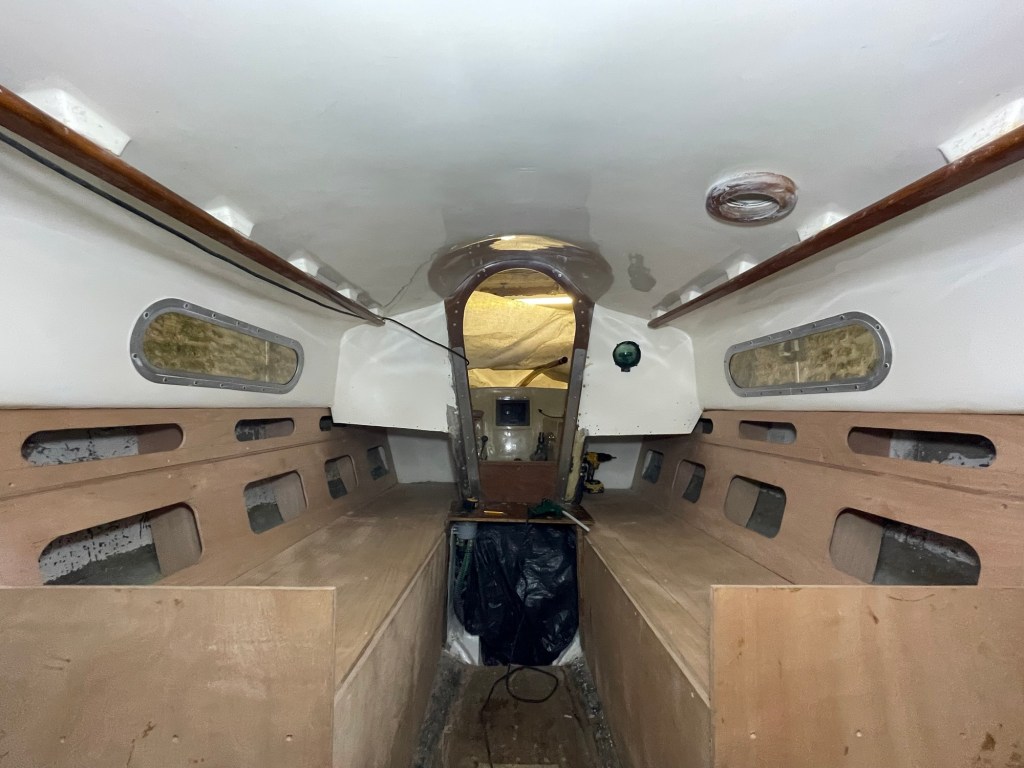
    Thankfully everything is in now (hopefully for good), and Tarka feels happier and stiffer for it!

    I’ll be painting and oiling next, followed by insulation above the waterline.

    The galley
  • … a new year glue-up?

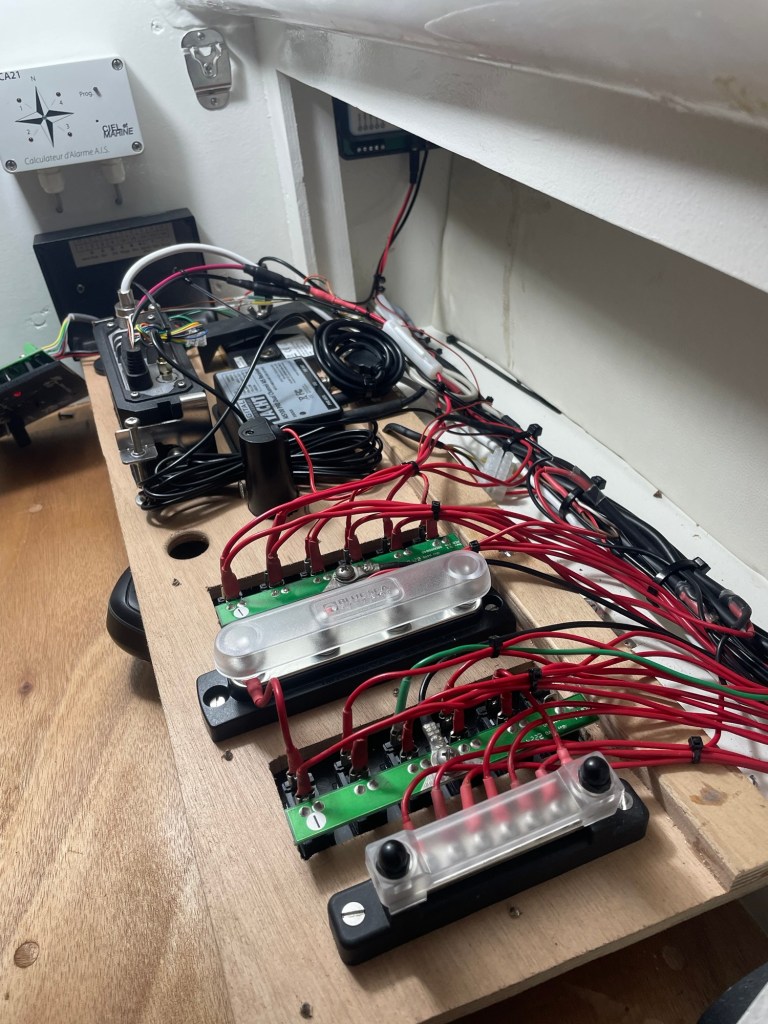
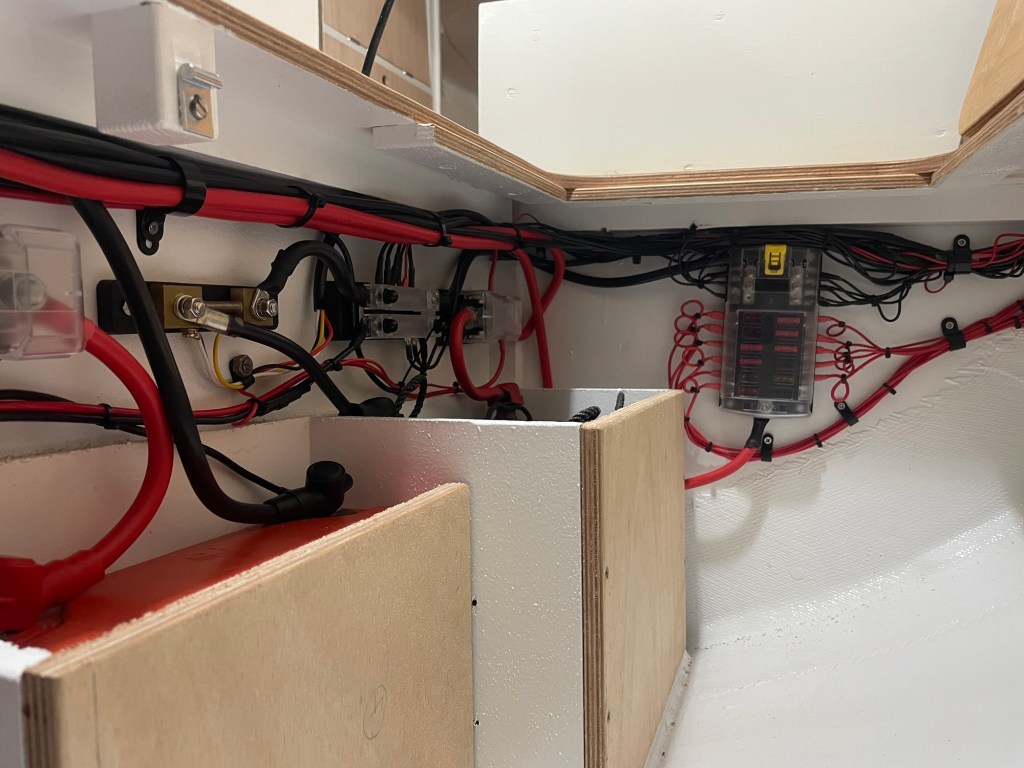
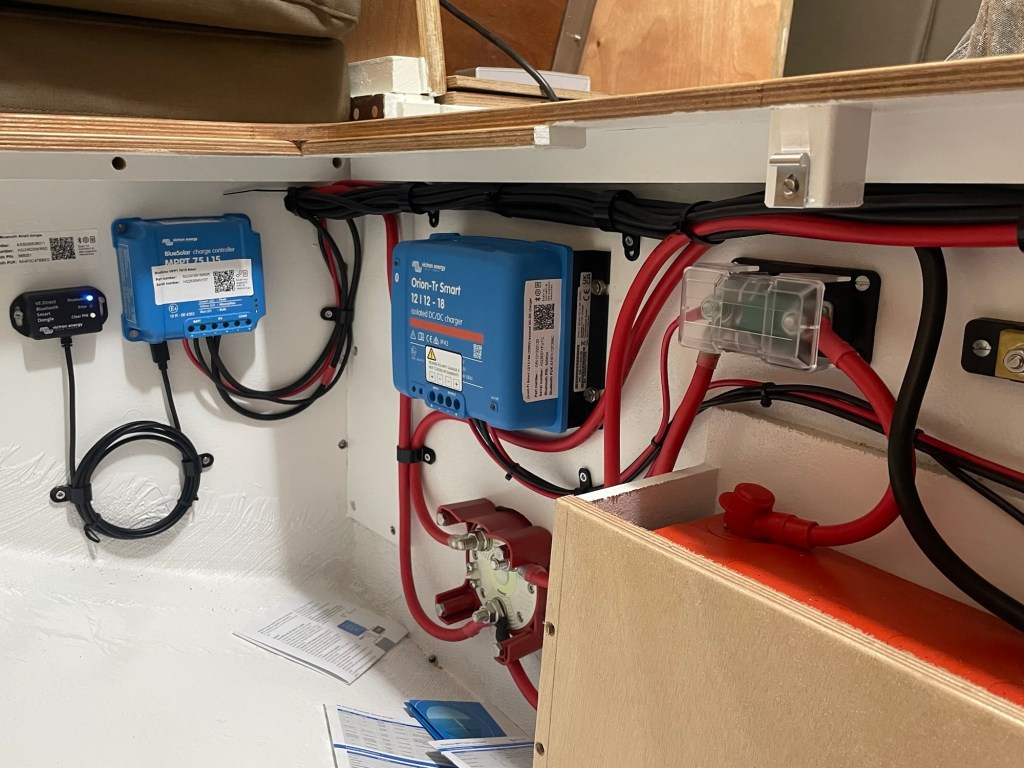
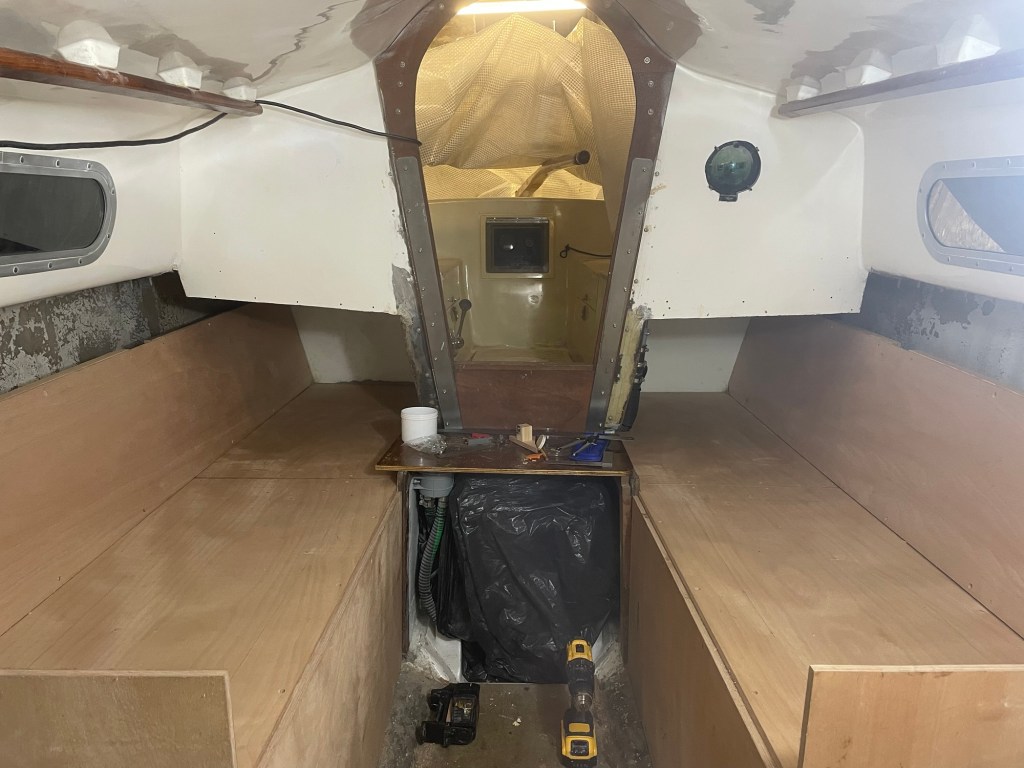
    I’m almost there with the rough interior install. The engine frame, main bulkhead curve, battery box, electrics and pan cupboard fronts and chart table carcass are all ready to be bonded in. Unfortunately I am still waiting for the gimbaling stove to become available (hopefully Jan) and will leave the galley as it is until that can be fitted.

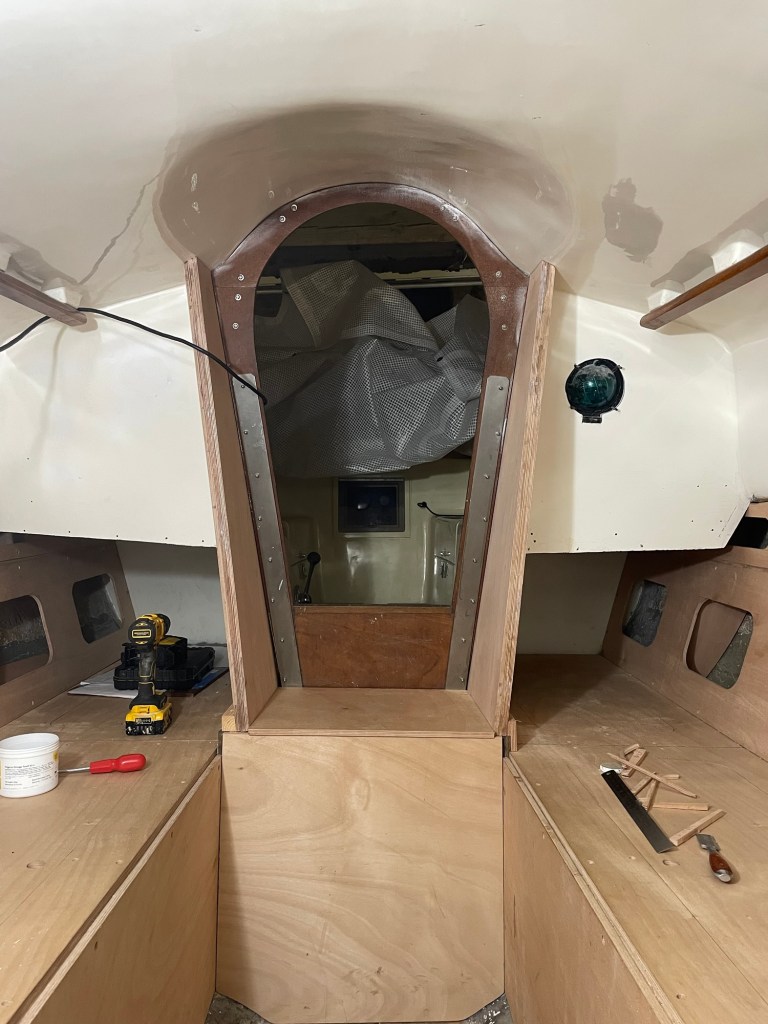
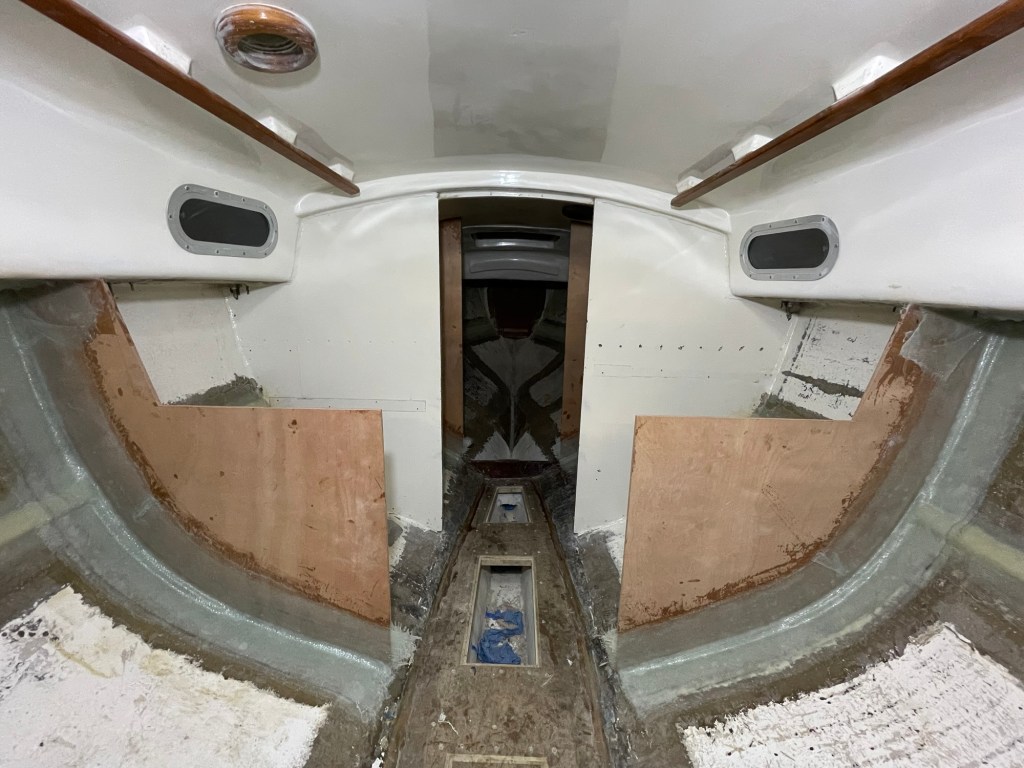
    The engine frame features ‘wings’ either side of the companionway and a removable casing for the engine.

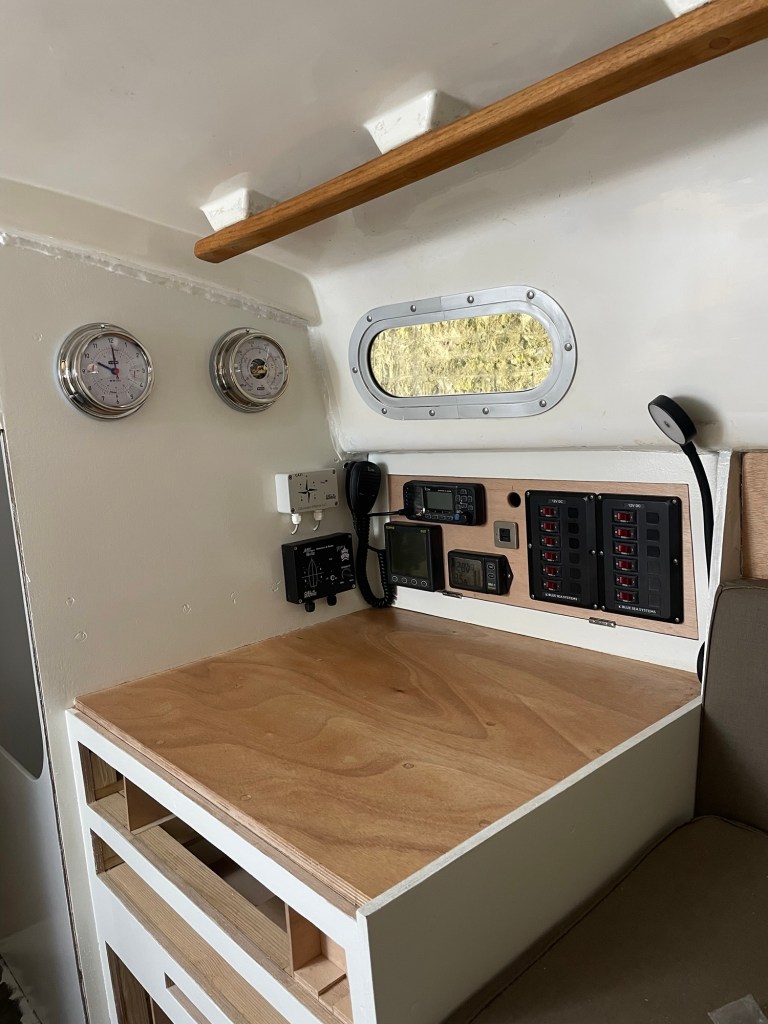
    The chart table carcass features a mount for a metal-working vice, drawers for the sextant and station pointer, four other general storage drawers, and a housing for a seat which will slide out of it and sit against the galley on the other side, allowing one to sit facing the chart table or galley.

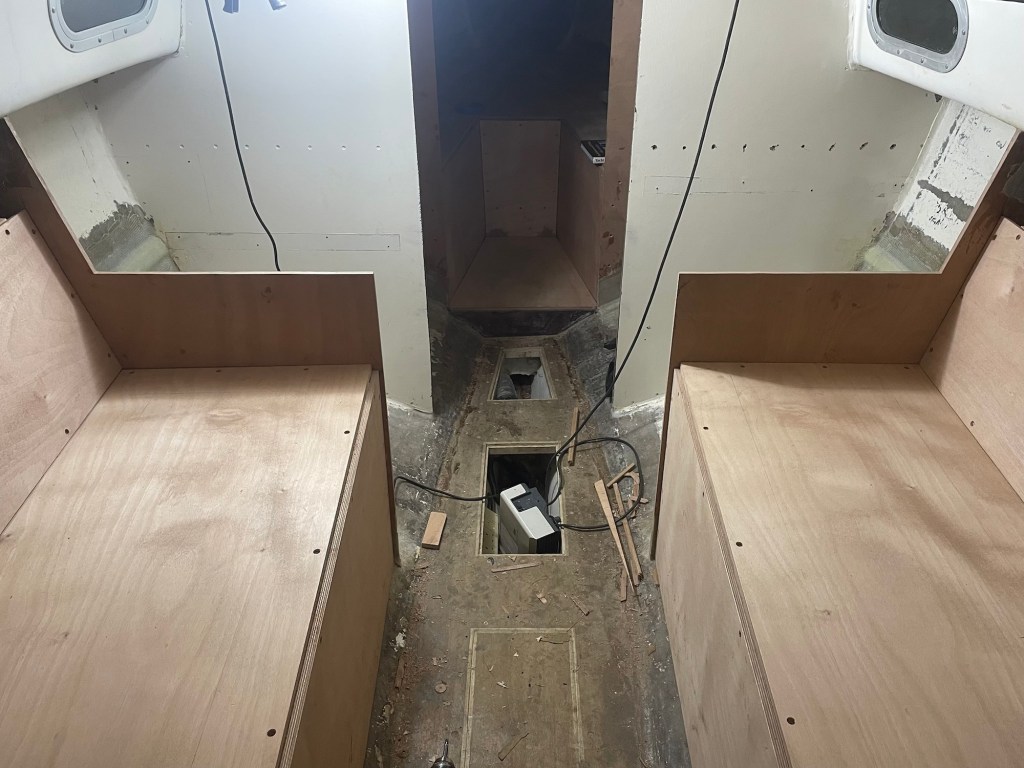
    Whilst I am nearly done for now, there will be more woodwork at a later date. There will be oiled Sapele trim along the length of the berths, on the edges of all the bulkheads and along the perimeter of the chart table and galley as well as more storage units on the bulkheads. I also need to cut and fit the cabin sole and bilge covers.

    Engine casing
    Battery box
    Chart table carcass
    Main bulkhead curve and locker fronts under the porthole.
  • Pushing for a Christmas glue-up.

    I was hoping to integrate my toolbox into a storage unit amidships on the port side, but it wouldn’t fit. Back to the drawing board.

    The redesigned area is a storage cupboard made up of lockers of different heights, filled to the brim with a selection of plastic boxes – corresponding to the heights of the shelves. It also features a thin shelf for sailing charts. The unit will have hinged fronts facing all the shelves, but they can’t be fitted until everything is screwed/glued.

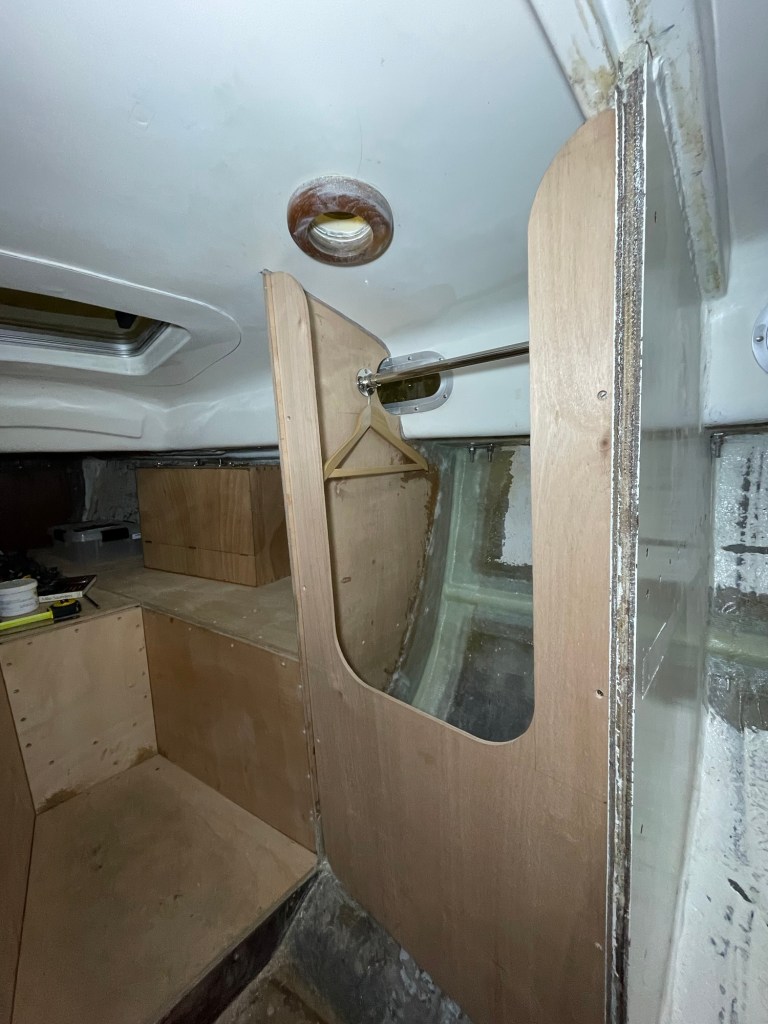
    The hanging locker has also been completed, and looks great!

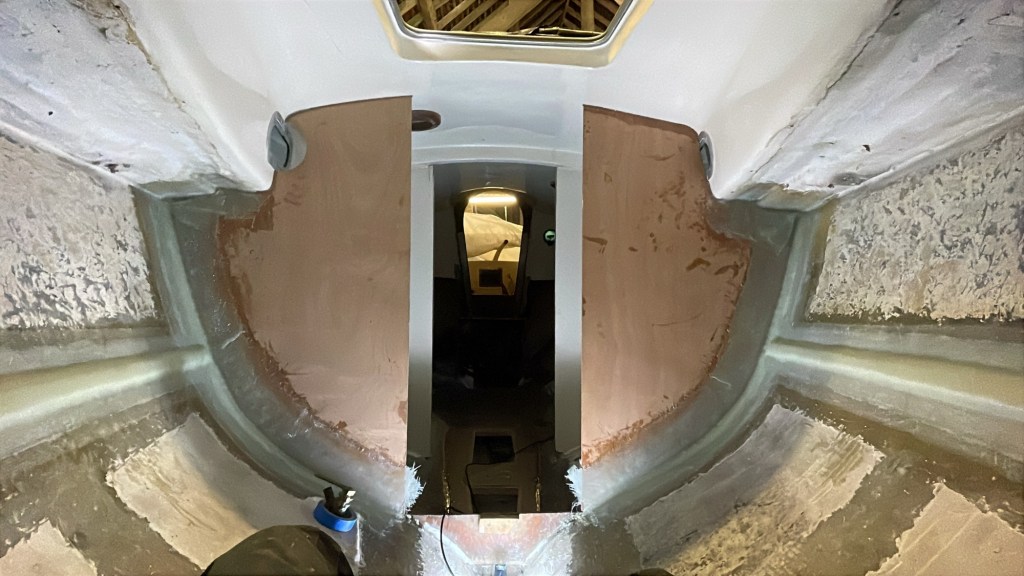
    I’m currently working on the ‘engine casing’ – the removable panels that sit in front and above the engine. I’m also fitting some thick ply panels to either side of the companionway which I hope to wedge myself into when it gets rolly!

    I’m hoping that with a bit of a push, I’ll have the engine casing, the galley and the chart table carcasses finished, in time to bond the whole interior in by Christmas!

    I had hoped to paint, oil and insulate by the new year, but I’d be surprised if I get that far.

    Hanging locker complete with stainless rail.
    Jam packed!
  • On to the next thing

    The seat backs are finished at last! I was determined to make the most of the space for storage behind them, as well as having a comfortable seating angle, so I had to go with my own design. The structure comprised two different-angled panels: one to support the seat back cushions, and a vertical panel above, behind which would be storage. I then templated, cut out and fit twelve dividers to split the lockers up. It came out alright!

    I also fitted the under-berth lockers with latches, to keep everything in them from pouring out if the boat went over!

    I’ll be moving onto the midships sections today; the hanging locker, port storage area, then subsequently the galley and chart table.

    V-Berth latches
    Quarter Berth latches
  • Baby steps…

    On reflection, personal and prompted by those around me, it seems I have been making steady progress over the last couple of weeks – and over the last few months since starting full time, despite it not feeling that way.

    I feel burdened with the load of work still to do, worn down by long hours in cramped spaces and am acutely aware of the temperature gently but steadily dropping.

    Having said that, the Forepeak now only requires the fitting of finger latches, a few more support cleats and the rounding of a few edges.

    I’ve also cut out and shaped the quarter berth tops, have made a good start on the seat backs and hope to finish them both this coming week.

    We press on…

    Lids and finger holes cut out.
    Showing the lips the lids sit on.
    Looking more like a cabin every day.
    Seat back panels cleated in.
  • First bunk top!!

    Good progress has been made since I wrote last: I started by bonding in the bunk dividers and cutting out the rest of the V-berth structure and the chain locker lid. I spent the next 6 days cleating up the whole interior ready for the bunk tops, and as of last night I have the first one cut out!

    Fitting the cleats took much longer than I anticipated but happily the process of spiling for and cutting out the tops has so far been quick and painless. Having the first bunk top on makes the interior feel one step closer to a cosy cabin!

    Dividers bonded in and chain pipe fits.
    V-Berth structure complete with cleats in place.
    Quarter berth cleats on. The aft cleats proved a nightmare as there’s very little to reference off for getting their height and angle right.
    Starboard quarter berth top on!! I’ve been looking forward to this moment since day 1!
  • Celestial navigation and bunks.

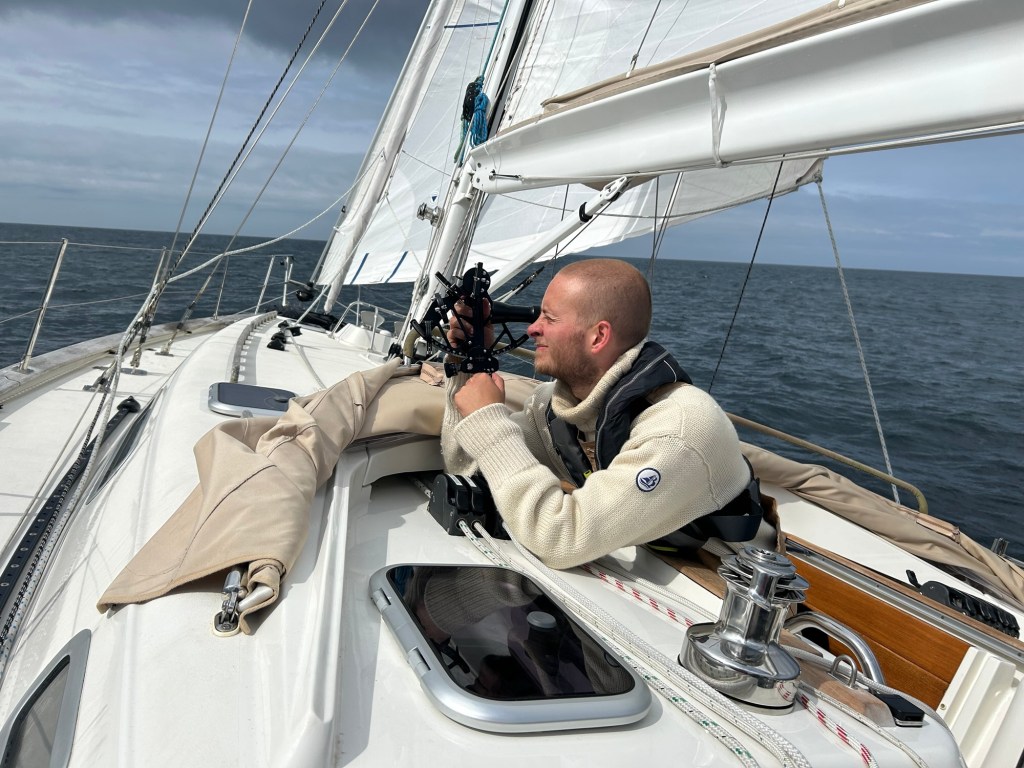
    As I write, I’m on my way back to Tarka to resume work. I’ve been away this past week studying celestial navigation, ocean passage planning and meteorology as part of the RYA Yachtmaster Ocean theory course.

    When offshore I plan to use celestial navigation as one of my primary methods of navigation (alongside a more manual approach to coastal work), supported by a backup gps fix from the radio/personal locator beacon. When one calculates their estimated position from landmarks ashore and in the sky they become intimately aware of what’s going on around them – infinitely more so than blindly following the chart plotter (not to say it’s always one attitude or the other). Similarly one often finds oneself blindly following the satnav in the car and having absolutely no idea how we got there or how to get back to where we departed from – without once again following the screen. I find this approach prudent given that a comprehensive understanding of your surroundings is vital in an emergency situation, and gives a much richer and more fulfilling experience.

    In other news, the bunk fronts are cleated and bonded in, and the bunk dividers are cut out.

    From today I will be bonding the dividers in, cutting and bonding-in the rest of the v-berth structure, cleating for the bunk tops, and then cutting the tops out.

    Aft bunk fronts and dividers.
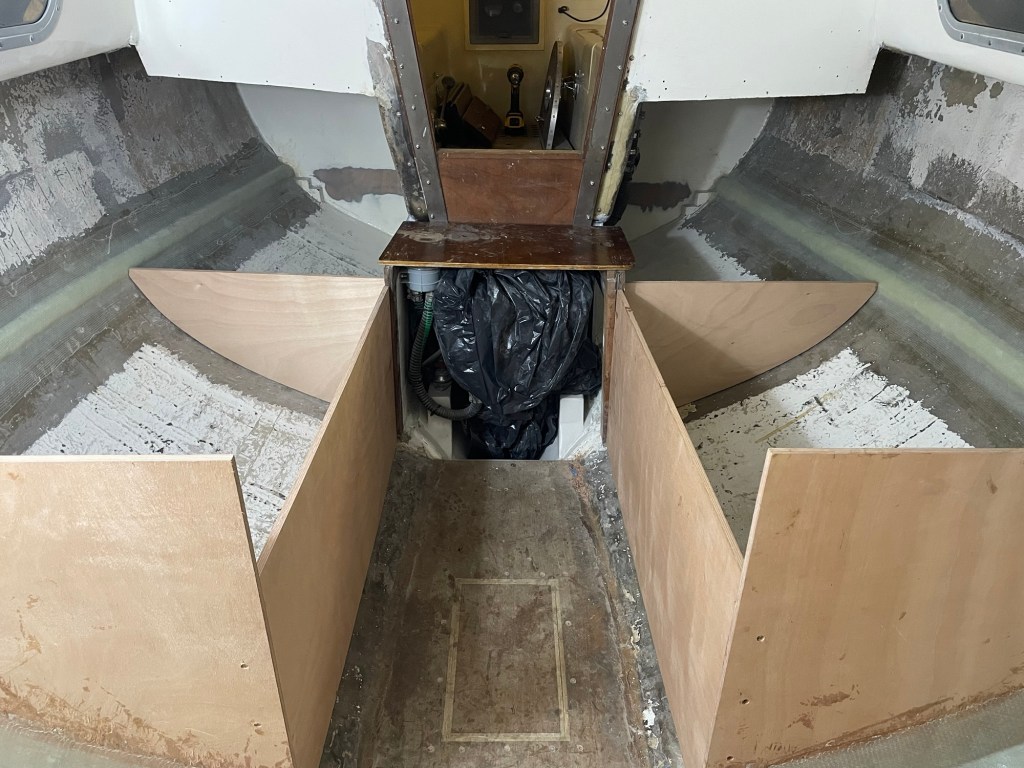
    V-berth fronts and dividers.
    Taking distance-off sights off the Dingle Peninsula, west coast of Ireland.
  • Work hard, get something done everyday. Easy!

    This week has been productive. Whilst there is progress everyday, it’s not everyday that the appearance of the interior changes so quickly. I keep reminding myself not to rush – as a reaction to my alarm at this rate of progress – but then backtrack and remember that the progress is simply proportional to the time spent working, time I now have in abundance. I’m relishing this time, well knowing that there will be months ahead when progress will seem tediously slow and far less tangible.

    The four main bulkheads have now been glassed in and I continue tomorrow with spiling and cutting the bunk fronts.

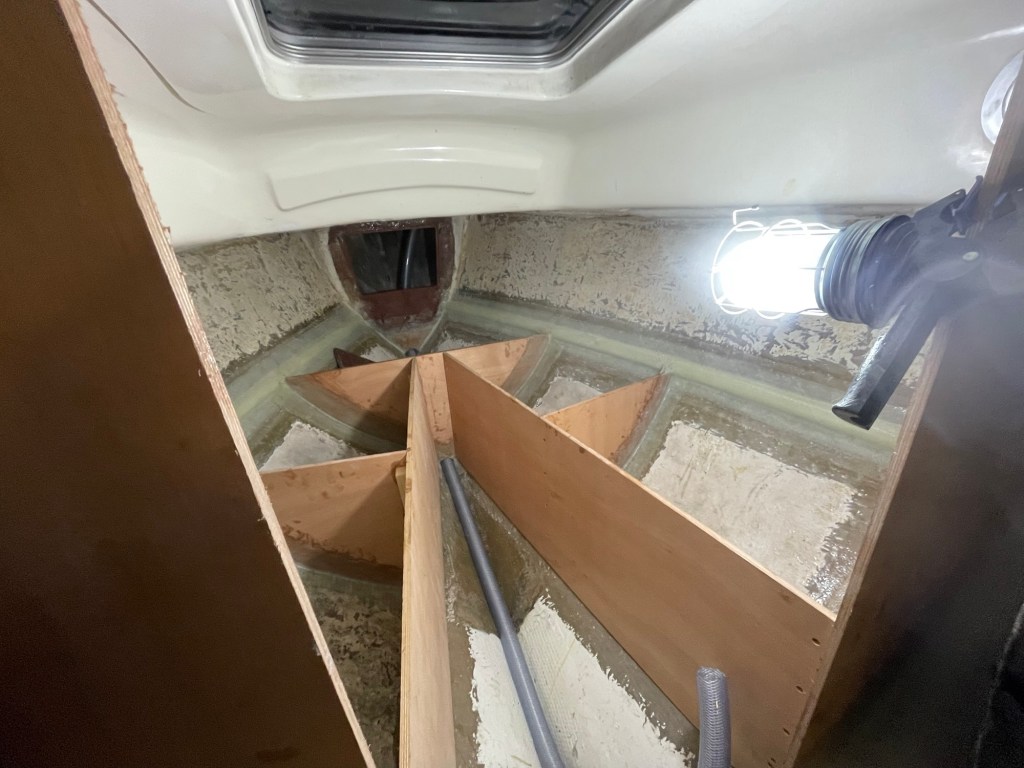
    This week’s niggle has been the storage of anchor chain, which I had to finalise in order to build the V-berth around it. I intended to run the chain through a deck fitting, down a hose-pipe along the centre-line of the boat to the forward end of the bilge. This required choosing a chain (of suitable strength) that had clearance inside a pipe, which was of a size that allowed it to be securely fastened to the underside of the deck fitting. On looking into it I was surprised to find myself looking at diameters of chain at this relatively early stage in the refit. Funny how one has to look so far down the line and cement tiny details in order to take steps forward in the present.

    The galley will be on the port side, chart table to starboard.
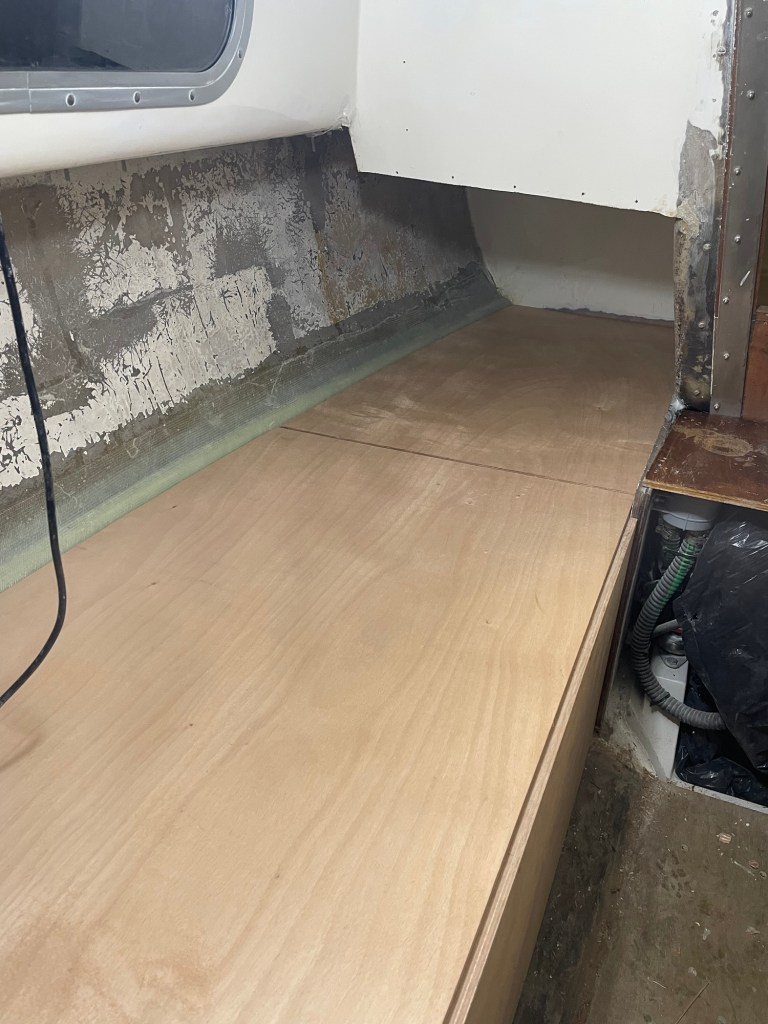
    Looking aft: to starboard will be a hanging locker (hence the cutout around the window) and to port, storage.
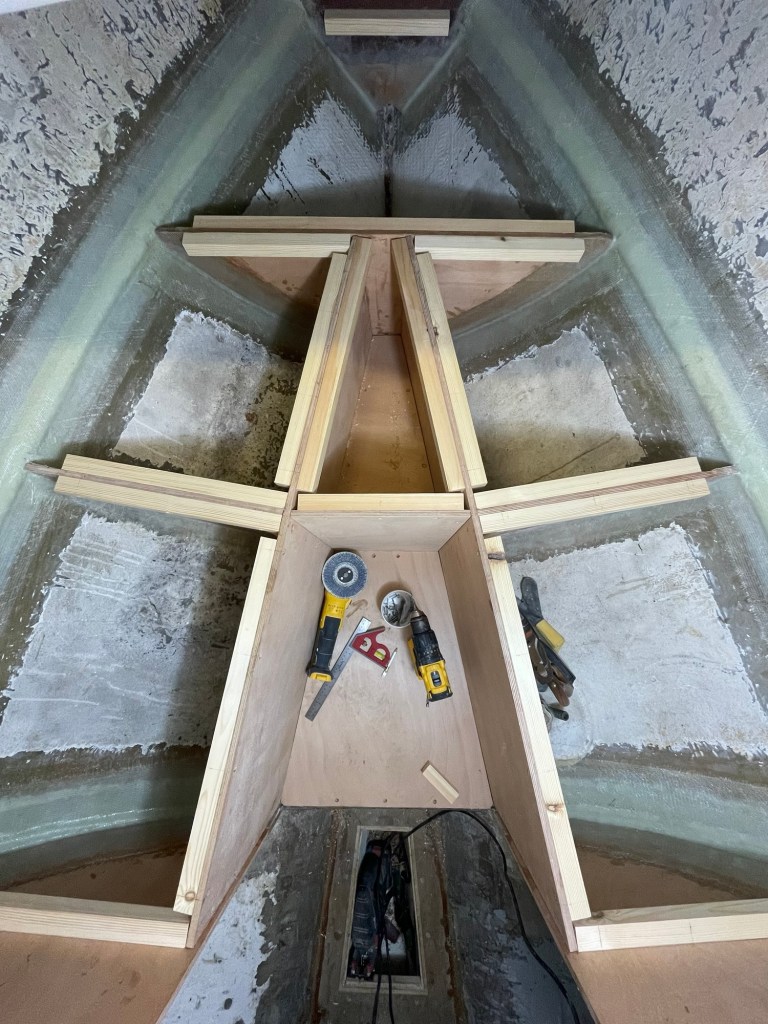
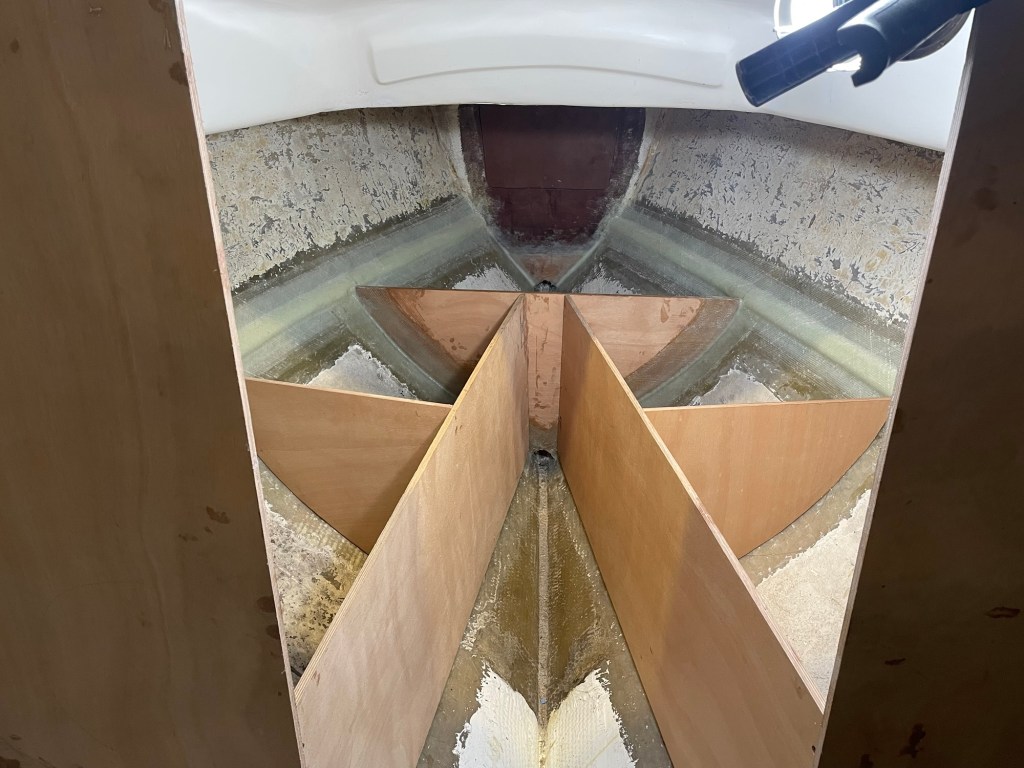
    Beginnings of the V-berth. The ‘chain pipe’ will run down the centre-line.
  • The Work Begins

    Having finished my degree and the furniture making course in Lyme Regis, my calendar is clear for an intensive nine-month burst of boatwork with the aim of getting afloat by May/June 2026. From the conception of my plans to the present day, they have consistently had to take second place to other commitments and responsibilities, so it feels amazing, and is a huge privilege to be finally able to dedicate my whole self to the project.

    Since coming back from Lyme I’ve been spiling, cutting and fitting four bulkheads, positioning them square to everything else and grinding the last remnants of old gelcoat (so the bulkheads can be bonded to bare fibreglass).

    Spiling aims to capture the imperfect curve of the hull side on a ply frame. This is then transferred to a solid ply template, and then to the final 12mm marine ply sheet which the bulkhead is cut out of.

    When bonded in with fibreglass, the bulkheads form the structural skeleton of the boat and provide surfaces which the four sleeping berths can be bonded to; thus completing the rough interior installation. The job wasn’t particularly difficult but often required one thing to be held in place while measuring or adjusting something else. This was made much easier by an extra pair of hands; my friend Nick came to help for a week.

    One unexpected job was to grind away a narrow channel of gelcoat on the coachroof where the forward bulkheads meet the ceiling. This required introducing the concept of precision to the angle grinder, which when added to working in a confined space with mask, goggles and headphones on, and above one’s head, turned out to be quite a job.

    I’ve also been designing the rest of the interior to make the best use of space and have enough drawers and lockers so all my worldly possessions don’t fly across the cabin if the boat was to be knocked down…

    Put to work!
  • Preparing for the interior

    I spent last week making some final preparations to the hull before fitting the interior. This involved adding “stringers” which spread the load of the interior fittings on the hull sides and add stiffness to the hull. They are normally bonded to the hull when it’s still in the mold, but as my boat was stripped when I bought it, they had to be retrofitted. Below shows the steps I took.

    It began with cutting and shaping polyurethane foam sheets into long thin strips. I spent day one cutting these out by hand, but after waking the next day, to my shoddy workmanship of the previous, I decided that shaping them with sandpaper was the way forward.

    Then I determined the exact position these foam strips were to take on the hull, so that the bunks would be exactly horizontal and the bulkheads vertical. For this I used a laser-level; I could’nt use a spirit level, nor the laser-level’s built-in gimbles, because Tarka is sitting on her trailer at a slight angle.

    Next I bonded the foam to the hull with thickened epoxy (overkill I know), and sealed with unthickened epoxy, in order to minimise the chance of voids forming under the glass as its an open cell foam. The foam adds no strength or rigidity in itself, but provides a form over which to lay the structural material, i.e. the fibreglass. Wood is sometimes used instead of foam but weighs more and is more time consuming to shape to the exact curve of the hull. I wetted out and rolled on 4 layers of glass (from first to last): 1x300g/m^2 powder bound csm, 2x600g/m^2 biax and 1x300g/m^2 biax. This was done for the forward and aft partial bulkheads, and the forward stringers. Unfortunately I ran out of time at that point and will have to return to the boat for a weekend to finish the job for the aft stringers. The gallery has been updated…

    Once I have completed the furniture making course I’ll be working full-time on Tarka to get her afloat by next summer. The remaining work is summarised below:

    • Fitting the self-steering windvane.
    • Designing, cutting out and fitting the partial bulkheads, galley area, chart table/workbench, hanging locker, berths, the many storage spaces aboard, and various miscellaneous fixtures.
    • Finalising the standing and choosing/sourcing the running rigging.
    • Choosing electrical navigation instruments, lights, communications instruments, and other electrical fittings, thus establishing my energy requirements.
    • Choosing and fitting a straightforward reliable electrical system to support these requirements.
    • Fitting a hand pump to my water storage system (jerry cans).
    • Fitting the gas cooker and small gas locker with bottle.
    • Choosing dimensions, designs and materials of ground tackle, bilge pumps, safety equipment, interior upholstery.
    • Getting the engine ready for action.

    In other news, our trio ‘Morse Contact’ has released its debut (self titled) EP. This features Cameron Scott on euphonium, Luke Purbrick on guitar, and me on drums. We showcase a couple of tunes we’ve been playing together over the last 18 months and include a few of my own! (“The Opener, “Without Expectation” and “The Raging Bull”). Thanks to Luke, we had the incredible opportunity to record at Abbey Road Studios. We are all very happy with the result so please have a listen if you’re interested!

    The EP can be found via the link below and is not available on other mainstream streaming services.